
How to Design High Performing Pinterest Pins: 9 Tips
Today, I’m sharing the various elements that go into creating high-quality Pinterest designs that will get you clicks!
These design elements will greatlyincrease your chance of showing up in Pinterest searches (alongside pin keyword research), resulting in more website traffic, leads and sales.

To make a pin successful, you must remember:
- You need to keep the Pinterest algorithm happy,
- AND keep the actual Pinterest user happy.
Keeping these 2 pieces in mind will help you use Pinterest to drive more traffic to your website, blog, or online store.
So, make sure to save this post so you can refer back to it when you’re creating your pins.
Before we get started, I’m going to assume you already know how to design a pin 🙂
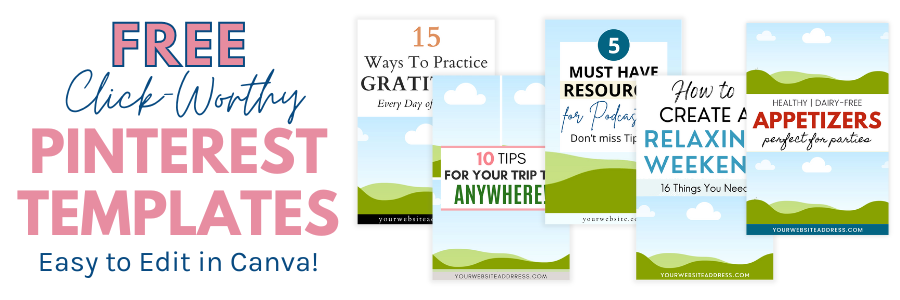
However, if you need a little help in this department, you can download my free Pinterest pin templates here…
9 Tips to Design High-Performing Pinterest Images
1. First Determine the Goal of Your Pin
First, what is high performing? Anything that helps you reach your business goals, of course.
Pinterest excels at showing your pins to an audience who is actively seeking out the content you provide.
They do a search on Pinterest, which shows their intent to learn more or find inspiration in a topic. And this specifically is why Pinterest is so powerful.
People aren’t just scrolling on Pinterest (like on social media), they are:
- Searching for inspiration and ideas
- Researching future purchases
- Saving pins to refer back to later
- Clicking on pins that drive directly to your website with the intent to read your content
- Looking for free resources (printables, eBooks, templates, etc), and signing up for lead magnets regularly
So, for every pin you design, make sure you know what you want people to do with it! This is your goal.
Goal examples:
- Click to your website to read content
- Click to your website to download a lead magnet
- Save to a board (great to increase overall account performance)
- Comment on the pin (same as above, great to increase account performance)
Once you know your goal, you’ll focus on this goal when designing.
2. Do not use the same Pinterest template for everything
Different Pinterest designs and text will appeal to different people, so try various background images, colours, fonts & copy and see what works for you.
I have noticed many people use one template for every single pin design. Let me tell you why I think this is a mistake:
- Pinterest has visual search functionality that help the algorithm understand the type of content.
- If all your content looks the same, Pinterest be as clear as to what the pin is above, so the algorithm won’t show it to anyone
- Try different designs to improve your pin performance. You may find that a different font or image stands out more, so more people click and save (this means Pinterest shows your pin to more people!)
- Make sure your images relate to your content. Pinterest is a visual search engine. If your image is a photo of yourself, but you write about money, for example, Pinterest and users will have a hard time understanding what your pin is about.
>> Check out 17 of the Best Free Stock Photo Sites you can use for your pins
3. Text in Your Pin Must Stand Out
You need to make sure the text in your pin design is EASY TO READ.
The majority of Pinterest users are scrolling through pins on their mobile devices, so if your pin designs are too fussy, people will keep on scrolling.
The goal: Catch searchers’ eyes and encourage them to tap to see the pin closer.
There are some easy parameters to follow for this:
- No more than 2 or 3 fonts in one design.
- Consider making an important word bold or a bright colour so it stands out.
- Example: If your pin is about awesome bullet journals – make sure ‘bullet journals’ is made bold, not ‘awesome’. This helps people quickly understand what your pin is about.
- Be careful how you use script fonts, as many are hard to read. Always look at your pins on your mobile phone and see how easy they are to read.
- When using script fonts, use it for the complimentary text only. In the bullet journal example above you could make the word ‘Awesome’ in a script font.
- You can also use works like ‘the’ or ‘and’.
4. Ask Yourself, Is Your Pin Helpful?
You must remember that a pin is being read by real people! Therefore, it’s important to cater to the Pinterest users’ needs and make your communications personal to them.
When creating a pin, always think about how you use Pinterest. You are looking around on Pinterest to help you accomplish a task or find a solution.
Let me ask you this. What pin title are you most likely to click on?
“How I spend my summer weekends with the family.”
“8 Fun & Affordable Summer Weekend Activities for your Family.”
I am going to bet that most people would click the 2nd example. Why?
- The pin copy is about them. It’s personal.
- It’s enticing.
- People LOVE lists, so having a number increases clicks.
- Best of all, it provides a solution and is communicated in a positive manner.
How? Someone searching for this might be in debt or on a very low budget, but this pin takes that problem, solves a problem and makes it attractive to learn more!
👉 The general rule of thumb when writing pin copy is: Solve a problem. Provide a Solution. Make it Easy.
5. Create Multiple Pin Designs for Each Post Or Product
Start with 2 or 3 Pinterest pin designs, see how they perform, and then create more of what’s working.
Test out different colours, fonts, background images and designs. Trying different design techniques will give you an idea of what designs work best for your content.
You’d be surprised that even the smallest change can make an impact on your pin’s performance.
This is a key component that will help you drive more traffic to your website over time.
>> Grab my free pin templates to try some new designs.
6. Test Pin Copy & The Call to Action
On top of testing the visual look of a pin, it’s just as important to test your communications within the pin design.
A call to action tells people what to do. Sometimes you might need to write ‘buy now’ or ‘learn more’ or ‘here’s how’.
Try different call to actions and see if this makes a difference to your overall pin performance and specifically your click-through rate*.
*See tip #9 for details.
7. Test New Things
You will get advice from everyone (including me lol), but don’t let that deter you from testing things for yourself.
Example: I have always ‘heard’ that pins with images showing a face don’t do well as they are apparently distracting, yet they have performed extremely well for my personal development blog content.
When I started blogging, I also used to hear that red never did well, yet I had mady pins with red colors to very well.
I think different styles of pins can work for different niches, so test your own theories.
Moral of the Pin Design story:
Get creative, try new things and see what performs for you!
8. Use The Right Keywords in Your Pin Description
Utilize Pinterest search to see what keywords people are using to search for content. Now, make sure to use these specific keywords in your pin descriptions.
How can you find the right keywords in Pinterest?
It’s super simple. Simply go to the Pinterest search bar and start typing in your query.

The results that are auto-populated are also some of the top terms people are searching for.
If you also just search for your base keyword – example ‘bullet journal’ and click enter you are given a load of relevant keyword suggestions.
These are used to help the Pinterest user narrow their search, but this also helps content publishers understand what keywords to target in their descriptions.

Use The Pinterest Trends Tool
Another helpful tool you can use is found in the dropdown of the Analytics tab in Pinterest’s navigation.
You can check out this week’s trends, but even more helpful is adding a topic/keyword to the search bar, like I did below.

(It’s pretty apparent if you write about bullet journals January is the time this content blows up!)
This is also a great way to do a little research in advance to help you come up with content ideas.
Access Pin Inspector
There is FINALLY Pinterest software on the market that helps you optimize for Pinterest and saves you loads of time!

Pin Inspector will help you:
- Get the best Pinterest keywords for your next blog post
- Spy on competitor pins that get the most saves and repins
- Combine Pinterest & Google analytics to help you choose the best topic for your next blog post
The best part is you can also install this on up to 10 computers.
Learn more about Pin Inspector HERE!
9. Understand Your Pinterest Analytics
Figure out the click-through rate of your most popular pins. This will determine how well your content is actually performing. After all, your #1 goal is to drive traffic to your website.
Your CTR Formula: Link Clicks divided by Closeups x 100. If this number is over 50%+ you are doing well. Keep working hard to increase this number even more.

With the above example, the CTR is 68%. This is a great click-through rate, but of course, I am always testing different tactics from this page to keep increasing it!
It’s also important to look at your Pinterest metrics every month so you can see what’s performing over time. This is a great way to keep track of the traffic Pinterest is driving to your website.
Related: Pinterest Analytics Metrics to Track Every Month + Free Pinterest Worksheets
A final note & Next Steps:
Once you implement the above pin design recommendations, you’ll have more control over how your pins perform.
It might seem like a lot, but once you start using these tips, it will become second nature.
Also, know that how a pin performs is down to consumer interest.
If your topic is really niche, it may have a lower impression count, but really high pin clicks or outbound clicks. Or you might have a really popular topic that has high impressions and a lower click-through rate. This is down to stiffer competition.
Understanding what works for your pins and how they perform will enable you to understand trends and will ultimately help you improve performance over time.
Last Thing To Note: Pins take longer to see a result than they did 5 to 7 years ago. So be patient. Keep following these rules, and don’t expect to see a true impact for 3 to 6 months – especially if your account is brand new. Pinterest is a long term traffic driving strategy.
>> Yes – it can take a while to start getting traffic, but once you get the engine working, you’ll never look back!
Next Step: Want to see The Anatomy of a Great Pin Design?
Download my free Pinterest Starter Guide…

You’ll get:
Have a Pinterest Design Question?
Leave it in the comments below!
More Pinterest Resources:
- How To Create Pinterest Board Names That Drive Traffic
- PinClicks Review: Is It the Best Pinterest Keyword Tool?
- Need more Pinterest Help? Sign up for an account audit.
- 25 Pinterest Templates: Edit in Canva

About Yolanda
Marketing Consultant & Web Designer
I help online business owners & content creators drive more traffic, leads & sales to stop guessing and start seeing real results.
With 25 years of online marketing experience, I teach proven strategies, tactics & tools to help you set & achieve your goals, in a way you never imagined possible. Learn more!
